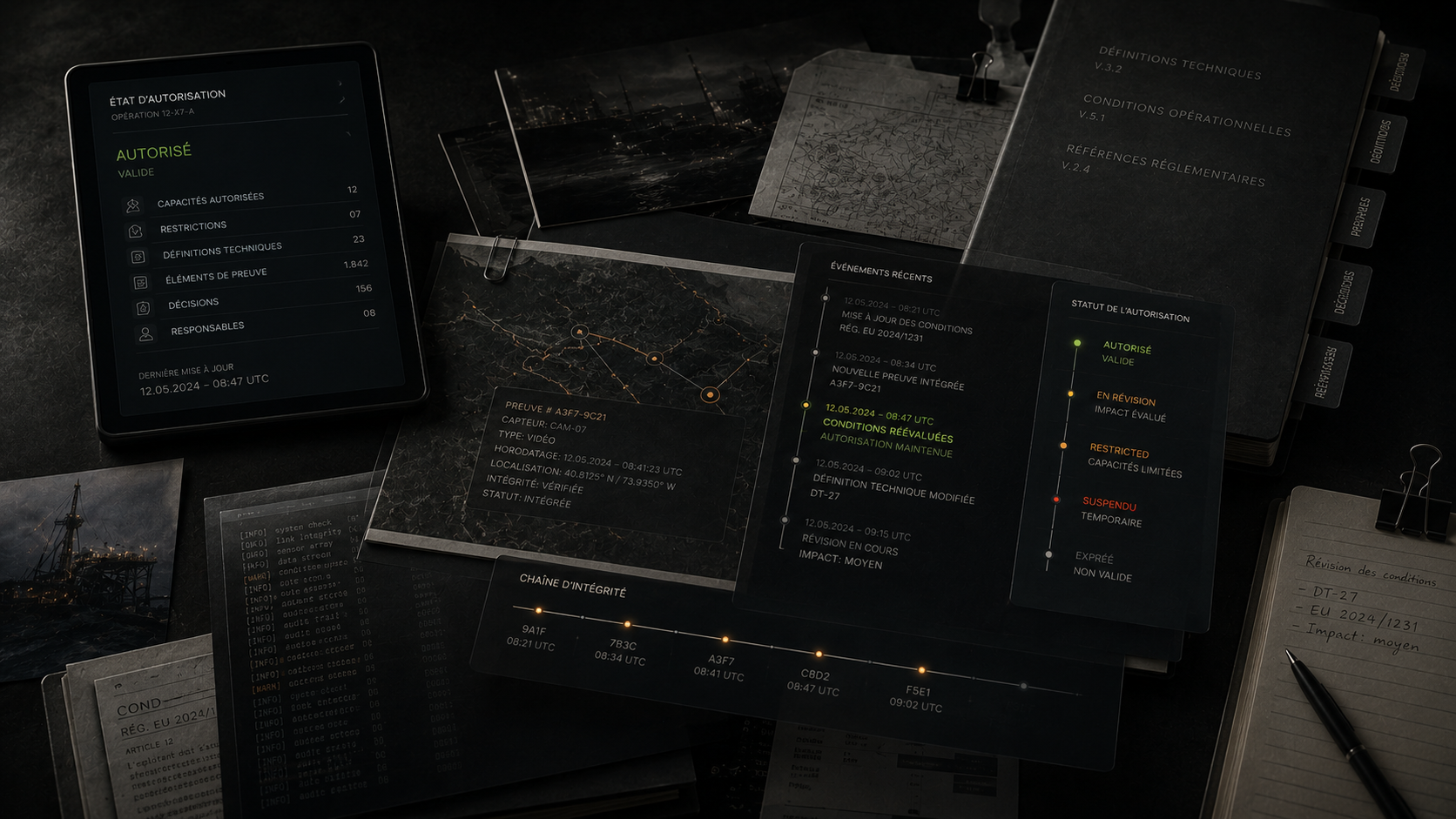
Clymene provides Phaeton, a governance software infrastructure that enables organizations to maintain decisional control over AI and autonomous systems.
Energy • Mines • Critical Infrastructure
For operations, legal, and compliance departments.


In an energy company, an autonomous pipeline inspection system is technically validated. The supplier certifies it. The teams approve it.
The Director of Operations refuses to sign.
Not due to a lack of technological trust, but because they cannot formally demonstrate the exact conditions under which the system is authorized, who is responsible at each stage, what evidence will be available in the event of an incident, or how to suspend the operation if the context changes.
The project is frozen.
This bottleneck is repeated in hundreds of organizations every year.
There is also no framework for documenting the trade-offs between compliance, operational continuity, and economic dependency on technology providers.
Why now
Regulations on AI and autonomous systems now place thousands of executives under direct personal liability for technologies they do not fully or permanently control.
According to Allianz, claims against directors and officers are continually increasing and have returned to or exceeded pre-pandemic levels in most regions of the world.
Today, the risk associated with an authorization decision often exceeds the technical cost of the system itself.

Phaeton transforms a one-time signature into a governed authorization over time.
Preserved Authority
Retain decisional authority even when the technology comes from third parties.
Explicit Responsibilities
Define the human responsibility associated with each system.
Defensible Decisions
Produce formal, traceable, and legally defensible decisions.
Suspension and Withdrawal
Define the conditions for suspension and withdrawal from the outset.
Supplier Independence
Preserve independence from technology providers.
The technology may evolve. Suppliers may change. The decision-making authority remains internal.
Phaeton is not a self-service tool or an application to be deployed on a large scale.
It is a software infrastructure activated for each critical system.
For each authorization, it produces three operational artifacts:
• a formal and versioned authorization sheet
• an entry in the central registry of authorized systems
• an opposable authorization file (PDF) for audits, authorities, and insurers
These artifacts are updated with every significant change to the system, the supplier, or the regulatory framework, serving as the official reference for the organization.
The authorization cycle
Phaeton structures the conditions of use for a critical system, the associated human responsibilities, the required evidence, and the operational and economic constraints impacting the decision.
The decision-maker authorizes the system under explicit conditions, with suspension mechanisms defined in advance.
Operating conditions are monitored over time. Deviations are detected and reported to the designated managers.
In the event of changes in the technical, operational, or regulatory context, the authorization can be formally suspended or withdrawn in a traceable manner.
Each authorization becomes a living object, maintained over time.


Phaeton is designed to structure and maintain operational authorizations within the most demanding frameworks, including:
• high-risk AI systems
• regulated cloud environments
• personal and industrial data protection
• cybersecurity and critical infrastructure resilience
• operation of autonomous systems subject to certification
Specific requirements are integrated according to the jurisdiction, the competent authority, and the technology involved.

Phaeton originated from a real-world industrial project involving the authorization of a critical autonomous system in a regulated environment. This project, essential to the operation of complex industrial infrastructure, was initially stalled—not for technical reasons, but because the authorization conditions, human responsibilities, required evidence, and suspension mechanisms were not formalized in a legally defensible manner.
To unblock the situation, it was necessary to:
• structure a formal operational authorization framework tailored to regulatory requirements
• explicitly define human responsibilities
• establish opposable suspension and withdrawal mechanisms
• gather verifiable technical and organizational evidence
The mechanisms developed to resolve this bottleneck served as the foundation for Phaeton and were subsequently generalized for other critical technologies and regulatory frameworks.

Phaeton is intended for organizations that must authorize autonomous systems or critical technologies in environments where a decision error directly involves human liability.
• operations management
• legal departments
• compliance and risk management departments
Clymene does not provide legal advice. Phaeton is an infrastructure used by these teams to structure, apply, and demonstrate the legal decisions made by the organization.
Phaeton is designed primarily for environments where technological decisions have major operational, human, or economic consequences:
• companies operating energy, industrial, or mining facilities
• essential network operators: electricity, transport, water, telecommunications
Other observed uses:
• certain regulated AI systems in healthcare and finance
• autonomous systems subject to regulatory authorization
• critical technologies provided by third parties
• multi-jurisdictional international deployments
• projects where the decision risk exceeds the technical cost of the system
Clymene is led by a team with experience in industrial, technological, and regulatory projects conducted in critical environments.
Former autonomous systems engineer at Inria. Founder of a company acquired by Capgemini. Managed a 100 million euro digital solutions portfolio in international regulated sectors.

Former Secretary of State for Communications and Executive Vice President of ARSAT. He led the deployment of a 34,000 km sovereign national fiber optic network serving 1,100 cities.
Clymene relies on a strategic advisory committee composed of senior profiles from:
• the automotive industry in France
• the energy sector in the United Kingdom
• the advanced robotics ecosystem in California
No.
Phaeton does not provide legal advice and does not replace internal lawyers or external counsel. Phaeton is a software infrastructure that makes it possible to structure, apply, and maintain over time the formal decisions made by the organization regarding the authorization and use of critical technologies.
No.
Phaeton does not remove human responsibility.
It transforms a one-time decision into a formalized, traceable, and governed authorization.
The decision-maker remains responsible, but they can precisely demonstrate:
• what was authorized
• under what conditions
• with what evidence
• and how the authorization can be suspended or withdrawn
Compliance tools describe rules and controls.
Phaeton governs actual operational authorizations.
It does not just manage policies, but the effective right for an autonomous or critical system to operate in a given context under explicit human responsibility.
Yes.
Phaeton is designed to work with technologies provided by third parties, including:
• autonomous systems
• cloud platforms
• industrial solutions
• specialized software
Phaeton does not replace these systems and does not pilot them.
It structures their authorization for use.
Phaeton does not consume real-time streams and does not require a continuous connection to operational systems.
With the client, representative data samples are selected, such as:
• operation logs
• technical reports
• system configurations
• supplier certifications
• incident reports
• evidence of testing or validation
These elements serve as formal references to:
• define authorization conditions
• verify compliance with them
• document compliance
• constitute an opposable file in case of audit or incident
No.
Phaeton works as a governance layer on top of existing systems.
It does not impose:
• modifications to the technical architecture
• intrusive integration
• specific instrumentation
The goal is to govern the usage decision, not the technical execution.
It depends on the scope of the project.
In initial deployments, the initial structuring of the authorization framework generally takes a few weeks.
Benefits appear as soon as the first formal authorization is issued.
No.
The founding case involved industrial drones, but Phaeton is designed for any system that is:
• autonomous
• critical for safety or operations
• subject to formal authorization
• operated in a regulated environment
As is the case today, the managers designated by the organization.
The difference is that Phaeton makes it possible to demonstrate precisely:
• who authorized it
• under what conditions
• with what evidence obligations
• and whether these conditions were met at the time of the incident
Because:
• systems evolve
• suppliers change
• regulations become stricter
• evidence must be maintained over time
• responsibilities must remain traceable
Phaeton transforms a static file into a living, monitored, verifiable, and opposable authorization over the long term.
No.
Phaeton does not replace financial tools or procurement processes.
It records the economic factors that influenced a decision (such as costs, supplier dependencies, assumptions, and budgetary constraints) so that the trade-offs made by executives are explicit, traceable, and reviewable over time.
Briefly describe your context. A member of the Clymene team will contact you to evaluate if Phaeton can be applied to your situation.